
[Peace In Your View] Father Philip Meraba on Faith, Social Care, and Peaceful Communities

Peace In Your View is an interview project developed as part of HWPL’s efforts to realize Article 10, “Spreading a Culture of Peace,” of the Declaration of Peace and Cessation of War (DPCW). Through in-depth interviews with individuals contributing to peace, the project seeks to illuminate diverse perspectives, experiences, and philosophies, while encouraging readers to reflect on how peace, inclusion, and social cohesion can be practiced within their own communities.
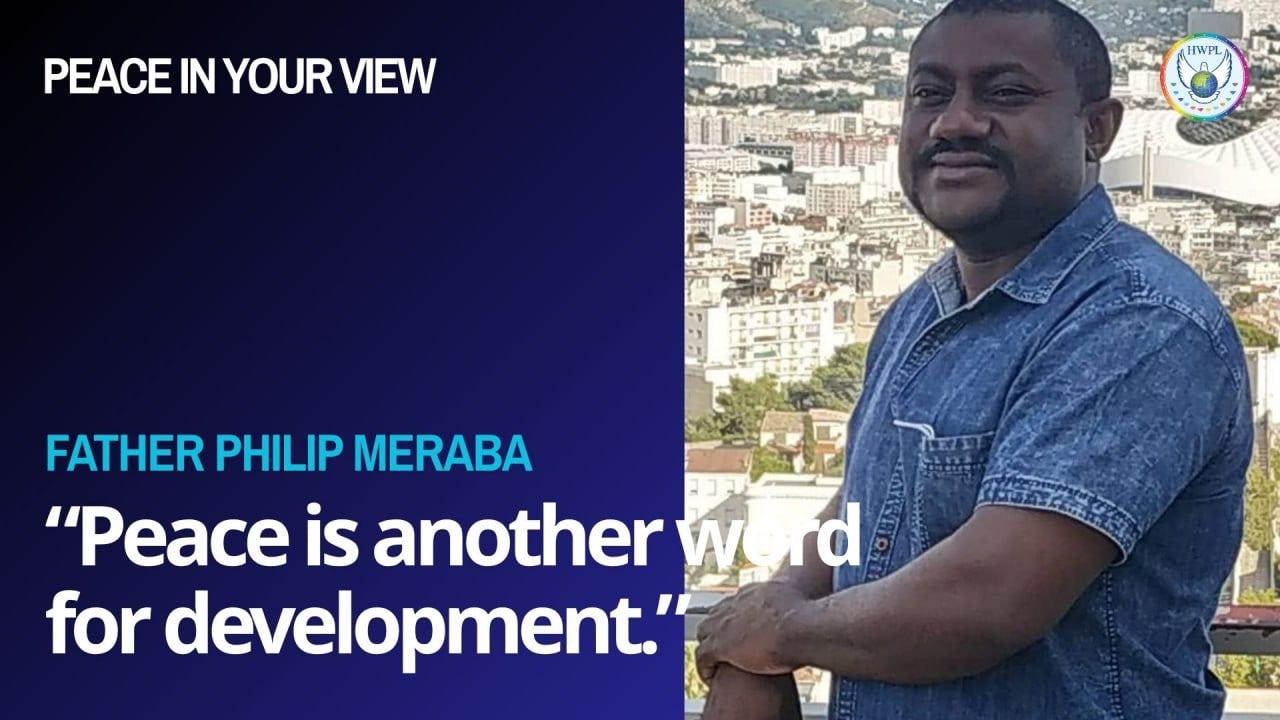
In this interview, Rachel Kim, Coordinator of the Religious Department of HWPL Global 08 Branch, met with Father Philip Meraba, a Nigerian Roman Catholic priest and member of the Missionaries of Africa. Currently serving at Saint Andrew the Apostle Parish in the Archdiocese of Lilongwe, Malawi, Father Meraba shared his missionary journey, community-centered ministry, and thoughts on poverty alleviation, youth empowerment, inter-religious dialogue, and peacebuilding.
𝐐. Could you introduce yourself and your current ministry in Malawi?
My name is Father Philip Meraba. I come from Nigeria, from West Africa, and I am a Roman Catholic priest. I belong to the Society of the Missionaries of Africa, commonly known as the White Fathers.
As missionaries, we are usually formed and sent outside our own countries of origin. Since my priestly ordination, I have worked in different countries. I first came to Malawi in 2011 and served here until 2019. After that, I went to Italy for further studies and earned a master’s degree in inter-religious dialogue and humanism. I later worked in Zambia, and now I have returned to Malawi for my second missionary journey.
𝐐. What does your ministry look like on the ground?
As a parish priest, my first responsibility is to take care of the spiritual life of the Christian community. We celebrate Mass, preach, and administer the sacraments.
But our ministry is not limited to the altar or to the church building. We believe that the human person is holistic in nature. So while we take care of the spiritual needs of the people, we must also respond to the social issues affecting their lives.
Our activities include housing support, school fee assistance, care for abandoned elderly people, medical support, food distribution, clean water projects, environmental protection, and youth workshops on drugs, alcoholism, gambling, migration, and human trafficking.
I cannot do all these things alone. Ministry must be carried out in collaboration. I work together with different groups in the parish, community members, and various partners.
𝐐. Among the many issues you address, what feels most urgent right now?
At this moment, one of the most urgent issues in Malawian society is poverty alleviation. If the social conditions of the people are not improved, the message of the Good News cannot be fully received by them.
If someone has not eaten for two days, can that person truly receive the message of the Gospel with an empty stomach? Therefore, the Good News has to go hand in hand with the empowerment of the people. We take care of spiritual needs, but we must not forget the material needs of the people.
𝐐. Why is inter-religious dialogue important to you?
Inter-religious dialogue and humanism are among the core values of the ministry of the Missionaries of Africa.
The German theologian Hans Küng said that there will be no peace among nations if there is no peace among religions. I deeply agree with this. The world in which we live is a world of religious pluralism, so there is a great need to learn how to respect one another’s faith.
Dialogue is not about teaching the other person. It is about learning what the other person believes and respecting that belief.
Our religious beliefs may be different, but humanity is one. The social issues I have mentioned — poverty, migration, human trafficking, and environmental problems — affect all of us, regardless of the faith community to which we belong.
𝐐. What do young people in Malawi need most today?
The young people in Malawi need education. After education, there has to be the creation of jobs and employment for these young people.
We often say that education is the key. But many young people come out of university and do not have a job for years. It is as if they have received the key, but the padlock has been changed.
This reality creates frustration, hopelessness, and a desire to leave the country. Young people need education, employment, guidance, discipline, and hope. For youth empowerment to take place, the church, the government, and the community must work together.
𝐐. Why is peace solidarity among religious leaders across borders and denominations important?
Every society needs peace. Peace can be understood as another word for development. A society cannot truly progress if it is divided or if it is not living in harmony with itself. For this reason, peace initiatives are necessary in every community, society, and nation.
When peace is promoted among religions and among different faith communities, it does not remain only within churches or religious communities. Because religious communities are at the service of local communities, that peace can be disseminated down to the level of communities and families.
𝐐. What are your plans for 2026, and what message would you like to share?
My plan this year is to create pastoral programs that respond to both the spiritual and social needs of the community I serve.
Of course, there are limits in terms of finances and resources, but we should not sit down and wait until all the necessary conditions are in place. We must look at what we can do with our own limited resources and begin with the little we can do now.
We should not be discouraged simply because what we are doing may seem very small compared to the magnitude of global problems.
No matter how small it may seem, we must do our own part. That small contribution is meaningful in itself, and it can create an impact somewhere. It can create change.
· Interviewer: Rachel Kim, Coordinator of the Religious Department, HWPL Global 08 Branch
· Interviewee: Father Philip Meraba, Missionaries of Africa, Saint Andrew the Apostle Parish, Archdiocese of Lilongwe, Malawi
This interview has been edited and finalized by the Public Relations Department of HWPL Global 08 Branch.