
Peace Is More Than the Absence of War: It Is Our Shared Responsibility

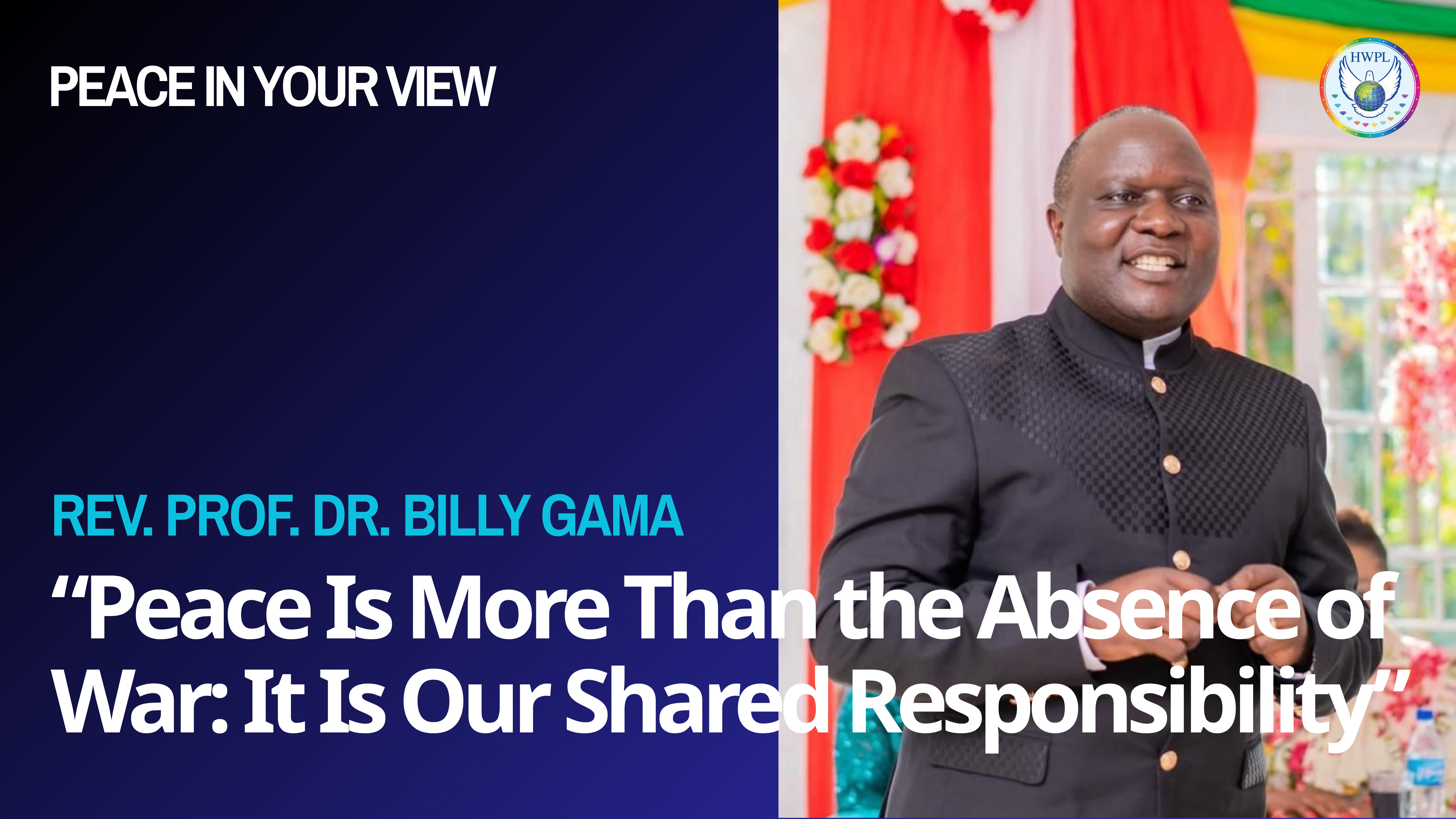
Peace In Your View is an interview series developed as part of HWPL’s efforts to advance Article 10, “Spreading a Culture of Peace,” of the Declaration of Peace and Cessation of War (DPCW). The series features peacebuilders from diverse backgrounds, inviting readers to reflect on how peace, inclusion, and social cohesion can be practiced in everyday life.
In this interview, Rachel Kim met with Rev. Prof. Dr. Billy Gama, Board Chairperson of the Malawi Council of Churches (MCC) and Executive Committee Member of the World Council of Churches (WCC). Drawing on nearly three decades of pastoral ministry and public service, Rev. Prof. Dr. Gama reflected on his calling to serve, the experiences that shaped his understanding of peace, and the vital role of faith communities in promoting justice, reconciliation, and human dignity. He also shared his perspectives on interfaith dialogue, community leadership, and how individuals can contribute to building a lasting culture of peace in their everyday lives.
Q. You have served both the church and society in many leadership roles. Could you briefly introduce yourself and share what continues to motivate your lifelong commitment to service?
I have served as a minister of the CCAP Blantyre Synod for nearly twenty-eight years, ministering in both urban and rural communities across Malawi. Today, I serve as Board Chairperson of the Malawi Council of Churches and on the Executive Committee of the World Council of Churches. Throughout my ministry, I have also had opportunities to serve Malawi in public leadership, including as Advisor on Religious Affairs to the late President Dr. Bingu wa Mutharika.
People often ask how I manage these responsibilities. For me, the answer is simple: God brought me into this world to serve. Titles have never been my motivation. Whenever I see an opportunity to help someone or strengthen a community, I believe it is my responsibility to respond.
Whether through ministry, education, or public service, my calling has always been the same—to serve others and help build a society founded on justice, compassion, and peace.
Q. Your journey into ministry began with an unexpected experience involving the French language. Could you tell us that story?
A. It was a turning point that changed my life.
After finishing secondary school, I applied to become a minister, but my application was rejected because I was only nineteen and the minimum age requirement was twenty-five. I was told to return six years later, and I was deeply disappointed because ministry had already become my calling.
Shortly afterward, I attended a youth leadership program on peace, justice, and human rights. During the program, a group of French tourists arrived seeking assistance. When no one else volunteered to help, I decided to speak to them in French. That unexpected moment caught the attention of the General Secretary of our Synod. He later encouraged me to reapply, arguing that my French-language ability should outweigh my age.
I was accepted into theological training, graduated as the top student in my class, and began my ministry. Looking back, I believe God opened a door that I could never have opened myself.
What seemed like an ordinary language skill later became an important part of my ministry. Through the World Council of Churches and other international organizations, I have used French while serving churches and partners across many countries. God was preparing me long before I realized it.
Q. Throughout your ministry, what have your experiences taught you about peace?
A. My ministry has taught me that peace is far more than the absence of war. In Malawi, many people live without conflict, yet they still struggle with poverty, food insecurity, natural disasters, and a lack of hope. Families lose their homes to cyclones, communities continue to recover from the impact of HIV/AIDS, and many people simply struggle to survive each day.
These realities have shaped my understanding of peace. A person without food, shelter, dignity, or hope cannot truly be at peace. Peace is not merely the absence of violence; it is the presence of hope, security, justice, and human dignity.
As religious leaders, our responsibility is not only to preach the Gospel but also to restore hope. Even when we cannot solve every problem, we can remind people that they are loved by God, created in His image, and never forgotten. Sometimes that hope becomes the first step toward rebuilding a life.
I often think of the biblical idea of shalom. Peace is a state of wholeness and well-being. Even a simple meal can bring joy when there is peace of mind, while material abundance means little if one’s heart is filled with fear or despair. That is why I always say that peace is more than the absence of war—it is the quality of human life itself.
Q. What role should religious leaders and local communities play in building a lasting culture of peace?
A. In Malawi, religious leaders remain among the most trusted voices in society, and with that trust comes great responsibility. However, peace cannot be built by governments alone. Political leaders, religious leaders, educators, traditional leaders, and ordinary citizens all have a role to play.
One of the church’s greatest strengths is its ability to bring people together every week. This creates opportunities not only to teach faith, but also to promote peace, justice, human rights, and responsible citizenship. Peace education should not remain within church walls; it should also take place in schools, families, workplaces, and communities. Through regular dialogue and shared learning, people develop the habits of listening, understanding, and resolving conflicts peacefully.
As religious leaders, we must also lead with integrity. We cannot remain silent in the face of injustice, corruption, discrimination, or violence. At the same time, we should not expect governments to solve every problem while asking nothing of ourselves. Each of us must ask, “What am I doing to build peace?”
Peace is built through small but consistent actions—educating others, showing compassion, encouraging dialogue, and serving our communities. When these values become part of everyday life, peace gradually becomes part of our culture.
Q. In many parts of the world, religion has sometimes divided people. How can faith become a force for peace instead?
A. Faith should always bring people together rather than drive them apart. One idea that has remained with me throughout my ministry comes from the scholar Bruce Milne: “Unity does not mean uniformity.” We do not need to believe exactly the same in order to live peacefully together.
Diversity itself is not the problem. Conflict begins when people refuse to respect the beliefs and dignity of others. As religious leaders, we should approach differences with humility, recognizing that none of us possesses complete knowledge and that we can always learn from one another.
Every human being is created in the image of God and has the freedom to follow their conscience. When we begin with that shared dignity, dialogue replaces hostility, cooperation replaces division, and mutual respect becomes possible.
Religious leaders therefore have a responsibility to become builders of reconciliation rather than sources of conflict. By encouraging understanding instead of exclusion, faith can become a powerful force for healing communities and creating lasting peace.
Q. Finally, what message would you like to leave with readers around the world?
A. My hope is that people everywhere will recognize that peace is not someone else’s responsibility—it belongs to all of us. Governments, religious institutions, educators, community leaders, and families all have important roles to play, but lasting peace begins when individuals choose to become peacemakers in their own daily lives.
I hope Malawi continues to move toward a future shaped by honesty, compassion, and cooperation. More importantly, I hope people around the world will make peace part of everyday life—not something we discuss only after conflict begins, but something we nurture in our homes, schools, workplaces, and communities.
For me, there is no value greater than peace. Wealth and success mean little if people cannot live with dignity, hope, and mutual respect. If each of us simply asks, “What can I do today to build peace?” and acts on that answer, I believe we can create stronger communities and leave a more peaceful world for future generations.
· Interviewer: Rachel Kim, Coordinator of the Religious Department, HWPL Global 08 Branch
· Interviewee: Rev. Prof. Dr. Billy Gama, Board Chairperson, Malawi Council of Churches (MCC) and Executive Committee Member, World Council of Churches (WCC)
This interview has been edited and finalized by the Public Relations Department of HWPL Global 08 Branch.