
Seungjeongwon Ilgi: 287 Years of State Records Preserved as Humanity’s Shared Memory
Beyond the King’s Daily Life: One of the Most Extensive Continuous Historical Records in Human History

Throughout human history, numerous dynasties and civilizations have left behind vast historical archives. China’s Ming Shilu (Veritable Records of the Ming Dynasty) and Qing Veritable Records are regarded as representative state chronicles documenting the reigns of emperors. England’s Domesday Book remains a foundational administrative record of the medieval state, while the Vatican Apostolic Archive is considered one of the world’s largest archival collections preserving centuries of diplomatic and religious history.
However, most of these records are either surveys from a specific period, historical compilations written after a ruler’s death, or collections of various official documents.
In contrast, the Seungjeongwon Ilgi, the Diaries of the Royal Secretariat stands out as an exceptionally rare case in world history, documenting the operation of government and the flow of society on a near-daily basis over 287 years. Beyond conversations between kings and officials, the records meticulously documented climate conditions, disasters, disease outbreaks, agricultural affairs, and the daily lives of ordinary people. As such, it transcends the role of a royal chronicle and functions as a living national archive that captures the multidimensional movement of an entire society.
For this reason, international scholars today regard the Seungjeongwon Ilgi as one of the most extensive and sophisticated continuous administrative records in human history.
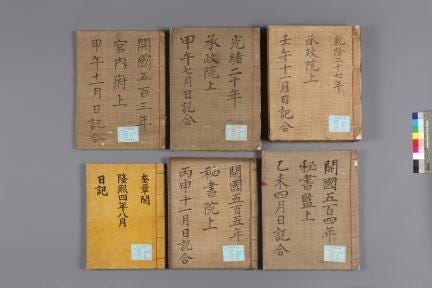
The Seungjeongwon, or Royal Secretariat of the Joseon Dynasty, was responsible for managing royal decrees and reporting state affairs, functioning in many ways similarly to a modern presidential secretariat. The Seungjeongwon Ilgi contains detailed records of political discussions, diplomacy, disasters, administration, and public affairs.
It is therefore regarded not merely as a historical account of kings, but as a vast “database of state governance” that reveals how an entire nation functioned.
The Continuity and Transparency of Records
The greatest value of the Seungjeongwon Ilgi lies in its continuity and transparency. The Joseon Dynasty viewed the systematic recording and preservation of governance not as an option, but as a fundamental responsibility of the state.
Importantly, the records did not focus solely on the glory of the monarchy. They also documented famines, epidemics, political conflicts, and administrative shortcomings with notable realism, giving the archive exceptional historical value.
This is precisely why modern international society emphasizes the importance of public transparency and national archives. Records are not merely tools for preserving the past; they are essential mechanisms for maintaining social accountability and collective memory.
The fact that political, social, cultural, and environmental changes were continuously documented over such a long period makes the Seungjeongwon Ilgi an extraordinarily rare case globally. As a result, the archive has become an invaluable source not only for Korean history, but also for the study of East Asian society and the broader development of human civilization.
Today, surviving volumes of the Seungjeongwon Ilgi span from the third lunar month of 1623, the first year of King Injo’s reign, to 1910, the fourth year of Emperor Sunjong’s reign. In September 2001, the records were inscribed on the UNESCO Memory of the World Register. UNESCO recognized the archive as an important documentary heritage that should be preserved and shared by all humanity.
This recognition signifies that the Seungjeongwon Ilgi is no longer merely a historical record of Korea, but part of the collective memory of humankind.
UNESCO Memory of the World - Seungjeongwon Ilgi, the Diaries of the Royal Secretariat
Ayoung K.