
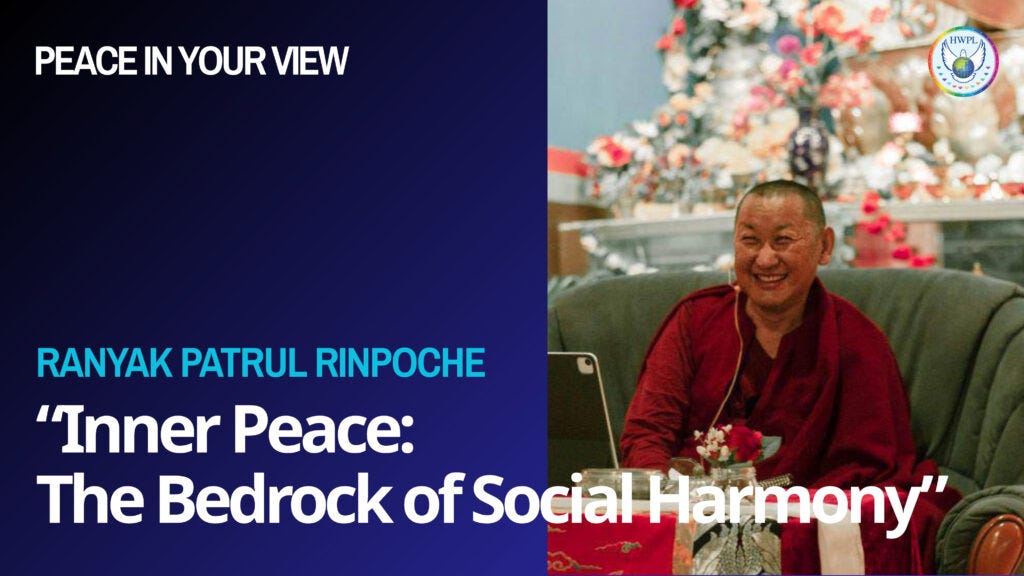
[Peace In Your View] “Inner Peace: The Bedrock of Social Harmony” – A Conversation with Ranyak Patrul Rinpoche

Peace In Your View is an initiative developed under HWPL’s efforts to realize Article 10, Spreading a Culture of Peace, of the Declaration of Peace and Cessation of War (DPCW).
By conducting in-depth interviews with individuals actively contributing to peace, the project seeks to illuminate diverse perspectives, experiences, and philosophies. Through stories shared by leaders, practitioners, and community members from various backgrounds, Peace In Your View aims to inspire readers to reflect on how they can promote peace, inclusion, and social cohesion in their own communities.
Born in Eastern Tibet and now rooted in Belgium, Buddhist leader Ranyak Patrul Rinpoche offers a profound remedy for the nihilism and division of the modern age: “inner education” and “interreligious dialogue.” We met him at Dharma City, his study center in Belgium, to discuss the path toward genuine peace.
Q1. Could you introduce yourself and share what brought you to Belgium?
I was born in Eastern Tibet, where I spent the first 30 years of my life. My journey eventually took me through India and Nepal before I settled in Europe nearly three decades ago. Today, I am a Belgian citizen.
My daily work involves two main paths: the academic side through my publishing house, Wisdom Treasury, and the spiritual side through Dharma City, a center dedicated to Buddhist philosophy. From a Buddhist perspective, my arrival in Belgium wasn’t a calculated plan but rather the result of karma—the conditions of life. Sometimes you aim for the East but end up in the West; I am simply happy that conditions brought me here.
Q2. What was the core motivation behind founding “Dharma City”?
I’ve observed that while modern society has achieved incredible material progress, many people still feel an internal void. There is a saying that material wealth cannot buy true happiness. You might see a person with very little singing in the sunshine, while a millionaire cries in a palace.
Dharma City was founded as a space for “inner education.” I wanted to create an environment where people could study Buddhist philosophy deeply—not just as a religion, but as a tool to investigate the mind and learn how to create harmony. We transformed an old farmhouse into this center so students could have a place to stay, reflect, and engage in dialogue with other faiths, such as the local Christian communities.
Rinpoche speaks with a gentle humility that makes even complex ideas feel accessible. He often emphasizes that peace begins with small, everyday actions—how we speak to our neighbors, how we understand our family members, and how we govern our own mind.
Q3. Many today struggle with depression, nihilism, and social division. What do you see as the root of these crises?
This is a profound issue. Today, many rely solely on material and scientific views. When one believes only in the physical brain, they often conclude that death leads to “nothingness.” This view can breed hopelessness and anxiety, especially as we age.
But even religious people sometimes depend too much on something external—a deity, a creator, or even the Buddha. Both extremes, nihilism and externalism, arise from not understanding the nature of mind.
In Buddhism, we believe suffering and peace do not originate from the outside; they arise from the mind. Emotions like anger and anxiety are internal products. Without inner understanding, people focus strictly on “you and me” and self-protection, which naturally leads to division. The more we develop materially without corresponding mental development, the more problems we seem to invite.
Rinpoche also highlights the importance of dialogue between religion and science. Many of his students with scientific backgrounds find that Buddhist teachings on the mind, causes and conditions, and emotional awareness complement their studies and help them understand how to work with anger and fear.
Q4. How does the Buddhist concept of inner peace scale up to global or social peace?
Peace cannot remain isolated within an individual. It requires education and dialogue so we can understand how our actions ripple through society. To achieve social peace, we must learn three things:
• How to govern ourselves
• How to understand the needs of others
• How to act with genuine compassion
Rinpoche explains that social harmony begins with awareness of how our behavior affects those around us. If we act selfishly, we disturb our neighbors; if we understand their needs, harmony becomes possible. This principle applies to families, communities, and nations alike.
Reflecting on Europe’s history, he notes that after the Second World War, many Europeans rejected violence. But as time passes, societies forget the suffering caused by war, and conflict begins to re-emerge. “That is why continuous education and dialogue are essential,” he says.
Q5. As a religious leader in Belgium, what is your ultimate goal?
My strongest wish is to foster more organized cooperation among different groups in Belgium. Currently, many communities live in isolation, which makes unity difficult. I want to keep building opportunities where people of all backgrounds can meet, introduce themselves, and work together for the collective benefit of the world.
For the past several years, I have also organized an annual “World Peace Prayer,” inviting Buddhist communities of all traditions—Tibetan, Chinese, Vietnamese, Korean, and others—to gather at Dharma City. There is no distinction of lineage or rank; anyone who wishes to come can join in praying for world peace. Although reaching other religious communities has been challenging, I hope this event will grow into a broader interfaith gathering.
Closing Reflection
Ranyak Patrul Rinpoche’s message is a reminder that peace is not a passive state, but an active practice of the mind. By shifting our focus from external accumulation to internal cultivation, we begin to build a more harmonious world, one thought at a time.
· Interviewer: Stella Seong, Coordinator of Religious Department, HWPL Global 08 Branch
· Interviewee: Ranyak Patrul Rinpoche, Founder of Dharma City in Belgium
This interview has been edited and finalized by the Public Relations Department of HWPL Global 08 Branch.
게시물 [Peace In Your View] “Inner Peace: The Bedrock of Social Harmony” – A Conversation with Ranyak Patrul Rinpoche이 에 처음 등장했습니다.