
[Peace In Your View] Interview with Apostle Dr. Evans K Kaping’a

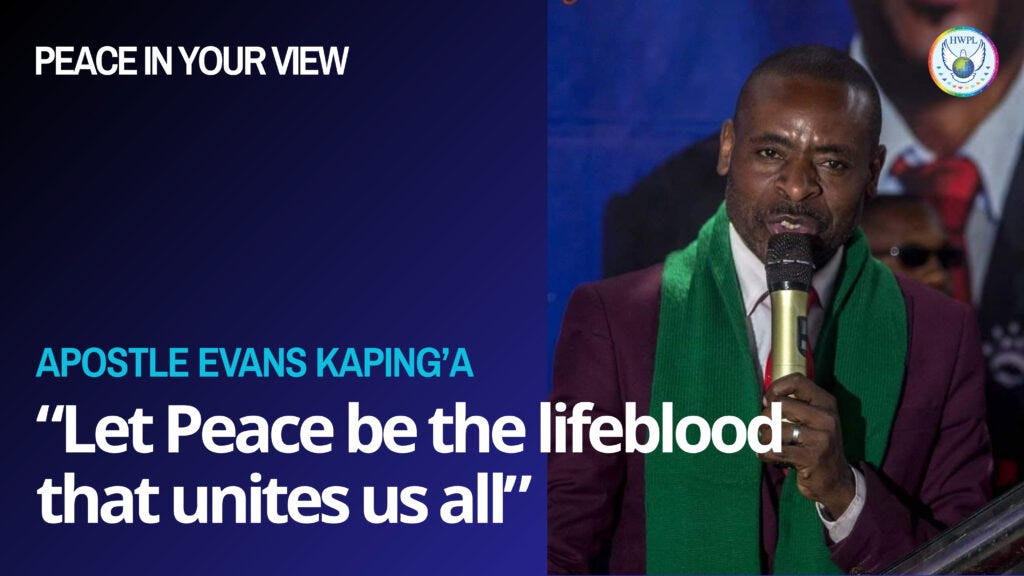
Let Peace be the lifeblood that unites us all
Peace In Your View is an initiative developed under HWPL’s efforts to realize Article 10, Spreading a Culture of Peace, of the Declaration of Peace and Cessation of War (DPCW). By conducting in-depth interviews with individuals actively contributing to peace, the project seeks to illuminate diverse perspectives, experiences, and philosophies. Through stories shared by leaders, practitioners, and community members from various backgrounds, Peace In Your View aims to inspire readers to reflect on how they can promote peace, inclusion, and social cohesion in their own communities.
Living the Responsibility of Peace in Zambia
In the heart of Southern Africa, religious leaders in Zambia serve as the moral compass for a diverse society.
Apostle Dr. Evans K Kaping’a, President of the Apostles Council of Churches in Zambia (ACOC), leads an institution that oversees numerous member and affiliate churches.
With a journey rooted in the Apostolic Faith Church and now presiding over one of the nation’s major church mother bodies, he emphasizes that peace is not a passive waiting game, but a daily responsibility of reconciliation and unity. In this interview, he shares how “red blood” unites us all and why dialogue must always triumph over violence for the sake of the next generation.
Q1. Could you briefly introduce yourself — where you serve, and what has shaped your journey as a faith leader?
I am Apostle Dr. Evans K Kaping’a, and I serve as the President of ACOC (Apostles Council of Churches), which is one of eight church mother bodies registered by the government. I come from the Apostolic Faith Church, but I am currently heading this institution, which oversees different churches and interfaith churches that are within our members and affiliates.
My journey of faith has taught me that true peace comes from trusting God. Faith has shown me that peace is not something we wait for, but it is something we live out daily through obedience, humility, forgiveness, and love. As a spiritual leader coming from the background of Christianity, the scriptures constantly remind us that peace is both a gift from God and a responsibility entrusted to us. God entrusted that peace, that responsibility to us, because peace should live within ourselves.
What I’ve learned throughout my journey is that it’s about reconciliation and unity. We have to foster reconciliation. We foster unity. When you are in conflict, there will always be misunderstandings. So I value so much respecting people’s opinions, respecting one another, and adopting to the situations where necessary, where it requires that peace to normalize.
We have to adopt to the situation and help out how people might reconcile. That is what I’ve learned throughout my journey. It’s about reconciliation, uniting ourselves together, forgiving each other, embracing each other, loving each other in humility, in respect, in whichever way that will make the calmness within the areas where there is misunderstanding.
Q2. When you hear the word peace, what does it mean to you — personally, spiritually, and for your community?
When I hear about the word peace, what it means to me personally, spiritually, and for my community is this: Peace is more than the absence of conflict. It is a state of inner alignment where the heart, the mind, and the spirit are in harmony with God and with the community or with one another. Peace begins within. But it must also be visible in how we relate with others. It is the quiet strength that allows us to face differences without fear and challenges without hatred.
Out there to the community, we have to see that people living in conflict situations are the peacemakers according to the word of God. The Bible says blessed are the peacemakers. So as a person who walks in peace, I need to make sure that I embrace everyone — whether old, young, rich, poor, even people living in conflict. It is my duty as the person who advocates for peace.
At one point, way back in 1998, I attended the International University of People’s Institution for Peace. That is in the sixth academic year in Italy. The annual course that I attended was about people’s diplomats, nonviolence, and the reconstruction of post wars. So personally, peace has to align with our hearts.
Q3. From your experience, what do you think are the biggest misunderstandings people have about your faith or about peace?
In today’s challenges, there are challenges that people face. There is a lot of misunderstanding. It may be that today there is too much division. That division can be either political, social, economic, even religious. People live in fear, misinformation, injustices, intolerance. That has continued to separate people. The loss of moral grounding leads to selfishness and disregard for human dignity. When values are weakened, peace becomes fragile.
In most cases, people have become so greedy, self-centered. They don’t like to collaborate with others. So it’s something that contributes to unrest among the society. The things that I have seen with a lot of people — divisions, misunderstandings, bring separation between people.
Let’s take, for instance, in our country where we have so many political parties, so many churches. This is where we see a lot of divisions. Because people tend to go to where they feel they can be accommodated. In the political realms or political dispensation, you find that people don’t actually go there for development, but for their selfish gain, leaving development behind. So those are the conflicts that we have seen so far. That’s what I can say according to what I perceive.
Q4. How do you and your community work toward peace — through programs, initiatives, or everyday practices?
Being a faith leader, you must be present in the community. In Zambia, I don’t know in these other countries, but I’m sure it is all the same. In Zambia, in communities, you find that there are churches. So as spiritual leaders, we are always there to make sure that the word of God is being preached, peace is being preached. Not only on the pulpit, but we contribute to peace by promoting dialogue, reconciliation, and social responsibility. This includes engaging civic leaders, youth, and other faith leaders.
So when we are in the church, we preach and advocate for justice, modeling peace and co-existence. Our actions outside the church must reflect the message we preach inside. When we are in the church, we preach messages that will bring people together, messages that will make people understand they are one. To the community out there, for them to understand what is going on. So mainly our bell or our modeling should be — we should advocate for justice, peace, co-existence. That is very, very, very important.
We promote dialogue, reconciliation, and social responsibility. If there are things that we have in terms of social responsibilities, where we see people are not actually meeting certain things, it is our role as spiritual leaders to make sure that we help them to meet their needs. We advocate. We reach out to the government. We reach out to whoever has the capacity to help so that they come on board to help people so that they live at peace, they live in harmony.
Because you see, in most cases, if people are lacking certain things, it becomes a challenge and very difficult for them to survive in life. But if we help them in that manner, it helps us bring reconciliation and peace in the society. I think we have a duty as spiritual leaders in terms of reconciliation and dialogue where there is a conflict situation.
Q5. What role do interfaith dialogue and cooperation play in your understanding of peace, and how have you experienced them so far?
The interfaith dialogue helps to bring people together. Remember, I’ve mentioned the issue of reconciliation. When we talk about dialogue, we are simply saying there is a conflict situation where there is a lot of misunderstanding. Now we want to bring the parties together so that they can also understand each other and come alive to one point of agreeing to certain areas.
So the interfaith makes the community understand different faiths. We learn about cross-cultural understanding. Cross-cultural understanding, even in the Bible, is there. The Jews were practicing different things. The Hebrews were practicing different things. The Jews were practicing different things. All in all, the common thing that they had was to worship God.
So when we are promoting dialogue, it means we are trying to bring the parties to one thing that they begin to understand what they are supposed to do in the society. If it comes to help development in the society, we bury the differences of people. We are saying, “I’m coming from this church, I’m coming from that church,” but we concentrate on the development. Because development has no boundaries.
Anyone… Death has no boundaries. Anyone can die. Anger has no boundaries. Anyone, whether Buddhist, whether Hindu, whether Christian, can still feel the same feeling that the other person is feeling. But for us to bring them, it is our duty to make sure that we preach to them what is required for them to start understanding. There is an issue, remember the issue of respect, respect to one another’s culture.
If they are doing the wrong thing, we begin to let them know what they should understand. We are not there to bring conflict in the society. We are there to bring peace. Wherever we go, we talk about peace. Whatever we do, when we walk, we walk peace. We talk peace. We sit in peace. Whatever that we are doing, our language should be peaceful.
So then the issue of misunderstanding, what we have at the moment in the community is part of misunderstanding. We have to bring transformation. Transformation, forgiveness, which leads to forgiveness and dialogue. Reconciliation. That is the major thing that deeply strengthens the commitment to peace. And peace is possible when people choose humility and love over pride and anger. That’s all.
Q6. Finally, what message of peace would you like to share with youth and future faith leaders?
That’s very, very important and very cardinal. Because whenever we are trying to do things, we should always think ahead. If I do this, what will happen to the next generation? The seed that I planted today has to germinate in the next generation.
So my message to the next generation is this: Peace begins with you. Peace begins with us. So we must choose to love over hatred, dialogue over violence, unity over division. And we have to be very courageous. Be very courageous enough to stand for what is right and compassionate enough to listen to those who differ from us. So the future of peace depends on our willingness to live it daily. That is how we should be.
The next generation must understand that it’s very important to choose dialogue over violence. Why should I fight my brother? Why should I fight my sister? Why should I fight another country? When all of us are breathing, all of us, we have the same blood.
The secret of God is that whether somebody is white, like yourself, I’m black here in Africa, but when we cut our skin, we find that the same thing that will come out from us will be the same thing. Although it might differ in grading or whatever scientifically, we have the red blood, meaning that we are one.
So our language should preach about unity, bring ourselves together, regardless of the race, regardless of where the person is coming from, whether a stranger, whether a person is known to me, whether a person is not known to me, but what is important is to embrace one another. That is my message that I have.
· Interviewer: Eustace Bae, Coordinator of Religious Department, HWPL Global 08 Branch
· Interviewee: Apostle Dr. Evans K Kaping’a, President of the Apostles Council of Churches in Zambia (ACOC)
This interview has been edited and finalized by the Public Relations Department of HWPL Global 08 Branch.
게시물 [Peace In Your View] Interview with Apostle Dr. Evans K Kaping’a이 에 처음 등장했습니다.