
[Peace In Your View] Rabbi Marianne van Praag on Leading with Intuition and Courage

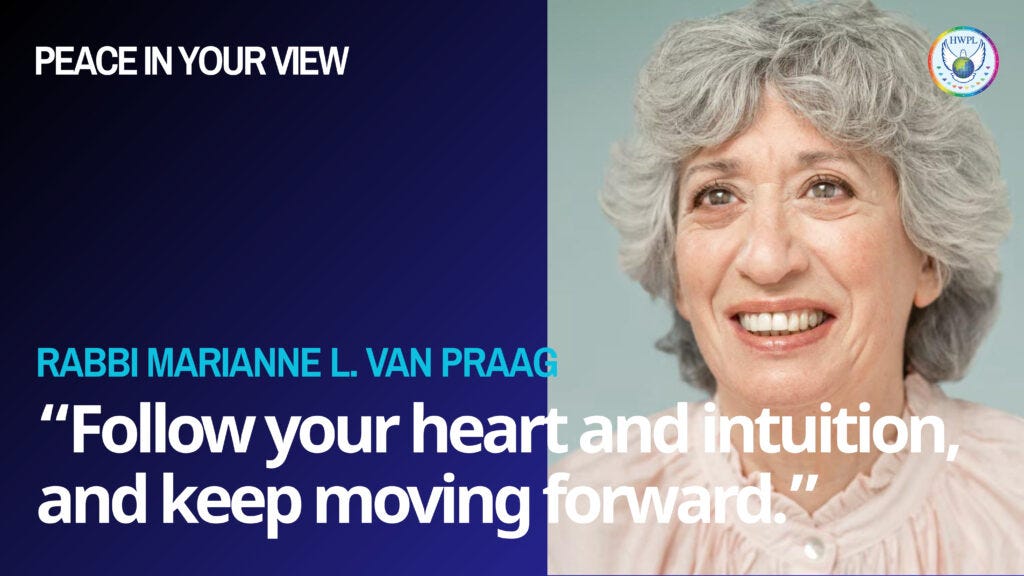
[Peace In Your View] Rabbi Marianne van Praag on Leading with Intuition and Courage
Peace In Your View is an initiative developed under HWPL’s efforts to realize Article 10, Spreading a Culture of Peace, of the Declaration of Peace and Cessation of War (DPCW). By conducting in-depth interviews with individuals actively contributing to peace, the project seeks to illuminate diverse perspectives, experiences, and philosophies. Through stories shared by leaders, practitioners, and community members from various backgrounds, Peace in Your View aims to inspire readers to reflect on how they can promote peace, inclusion, and social cohesion in their own communities.
In this episode, Rachel Kim interviewed Rabbi Marianne L. van Praag from The Hague, a liberal Jewish community leader. The conversation explored Rabbi van Praag’s lifelong journey, her leadership philosophy, and the challenges and rewards of guiding a small but resilient religious community. Through her personal story, the interview emphasizes the importance of intuition, empathy, and courage in building a hopeful future and fostering dialogue across different faiths and cultures.
𝐐. Introduce yourself and your community in The Hague.
My name is Marianne van Praag, and I am a liberal rabbi in the Netherlands. In Judaism, there are many different streams, and being a woman in this role already places me in the liberal tradition.
The Jewish community in the Netherlands is very small today. Before World War II, there were around 120,000 Jews; afterward, only about 20,000 survived. The Hague, in particular, lost the highest percentage of its Jewish population. After the war, the community had to rebuild everything from almost nothing—homes, families, livelihoods, and the community itself.
Today, we estimate about 60,000 Jews in the country, but only around 8,000 belong to organized communities. In a population of 18 million, that is extremely small—yet many Dutch people assume there are far more. The gap between perception and reality is quite striking.
𝐐. What inspired you to become a Rabbi, and could you share both a moment when you felt “this is truly my calling” and a moment when you found the role very challenging?
I always felt there was something meaningful I was meant to do, but for years I didn’t know what it was. I worked as a teacher, a tour guide, even at the Israeli embassy—but the feeling remained.
Then, at age 45, a friend told me about the opening of the first Rabbinical Education Institute in the Netherlands. I applied, and the moment I walked through the door, I knew: “This is it. This is what I’ve been waiting for.”
Interestingly, I now serve as rabbi in the very community where I grew up and spent decades advocating for women’s roles. For 40 years I fought to open leadership opportunities for women in what was supposed to be a liberal community. I once said I would never serve as rabbi here—yet here I am. Life has a sense of humor.
The challenging part of my role is being in the middle of many perspectives. People don’t always agree, and as a liberal rabbi, I sometimes prioritize intention and compassion over strict religious law. For example, in a recent funeral, I honored the wishes of someone who was not officially Jewish according to traditional law. For me, respecting a person’s final wishes matters more than rigid interpretations made long ago.
Following intuition is essential in my work. Your head can confuse you, but intuition rarely does. If you truly believe you are doing the right thing, you must stand by it.
𝐐. What is your leadership philosophy at LJG Den Haag, and what core activities is the community currently focusing on?
As a religious community, our core activities center on life-cycle events—births, bar and bat mitzvahs, marriages, illness, and death. Being present in people’s lives is the heart of the work.
My leadership philosophy is rooted in openness and collaboration. For 14–15 years, I’ve been involved in interreligious committees, community networks, and social initiatives. We keep our synagogue doors open. Many visiting students or community groups meet a Jewish person or enter a synagogue for the first time through us.
I also had to guide my own community to understand that leadership is not about gender but intention. After decades of advocating for women’s participation, I believe we’ve made meaningful progress.
So my philosophy is simple:
– Be present
– Be honest about our traditions and struggles
– Build bridges within the community and beyond
We don’t have many young people in The Hague—most move to Amsterdam. And in general, Dutch youth are more drawn to spirituality than organized religion.
We try to make space for younger people, but it’s not always easy. Older members often want things to stay as they are, so finding balance is an ongoing challenge.
I am retiring soon, and our new rabbi is a young, dynamic leader in his early 30s. I hope he will build stronger connections with the younger generation. He understands social media and modern communication far better than I do.
Jewish tradition can offer hope by showing that rebuilding is possible—even after deep trauma. After the Shoah, the community had to reconstruct everything. That history teaches that you can experience something devastating and still create a meaningful future. It’s a powerful message for any generation.
𝐐. In the multicultural context of The Hague, what unique strengths does your community bring, and how do you engage across different faiths and cultures?
One of our strongest points is openness. We welcome many school classes, churches, and community groups. For many, it’s their first time meeting a Jew.
We also receive many Muslim visitors. They often say, “We look alike,” and we talk about food laws or prayer traditions. They are surprised to discover how much we share. My goal is for people to recognize common values and respect differences.
When I speak in churches, people sometimes say, “But you didn’t mention Jesus Christ.” I remind them respectfully that while they see Jesus as divine, we do not—yet we can still respect each other’s truths.
In Hebrew, the word for truth—emet—contains the words for “mother” and “death.” The only absolute truths are that we are born and we die. Everything between is interpretation. Understanding that helps us coexist.
So our message in a multicultural society is:
– We share more than we think
– We can respect different truths
– Differences don’t need to be feared
𝐐. How can religious communities contribute to peace and social cohesion in the Netherlands today?
Religious communities can help society by encouraging people to acknowledge pain—both their own and others’—and still move forward.
There’s a biblical story about Lot’s wife, who became a pillar of salt because she looked back instead of forward. To me, the message is that when we hold on to past hurts, we become stuck.
We can’t change the past, but we can shape the future. Peace-building requires recognizing each other’s suffering and then choosing to build something new together.
I see the Bible not as history, but as the story of human beings making mistakes and learning. If you don’t make mistakes, you don’t grow. That understanding helps communities foster peace and connection.
𝐐. If you were to send one message to youth networks across Europe, what would you wish to share?
Young people truly have the potential to create change—far more than large institutions sometimes do. If you have a dream, pursue it with conviction.
If you know you’re on the right path, don’t let anyone talk you out of it just because it’s difficult or uncertain. Your intuition will guide you more faithfully than your doubts.
That is the message I want young people across Europe to remember.
· Interviewer: Rachel Kim, Coordinator of the Religious Department, HWPL Global 08 Branch
· Interviewee: Rabbi Marianne L. van Praag, Liberaal Joodse Gemeente Den Haag (LJG Den Haag) in Netherlands
This interview has been edited and finalized by Public Relations Department of HWPL Global 08 Branch
게시물 [Peace In Your View] Rabbi Marianne van Praag on Leading with Intuition and Courage이 에 처음 등장했습니다.