
[Peace In Your View] Remembering Bikini and Enewetak: Nuclear Memory, Responsibility, and the Path to Peace

Why the Bikini and Enewetak Nuclear Tests Must Be Remembered
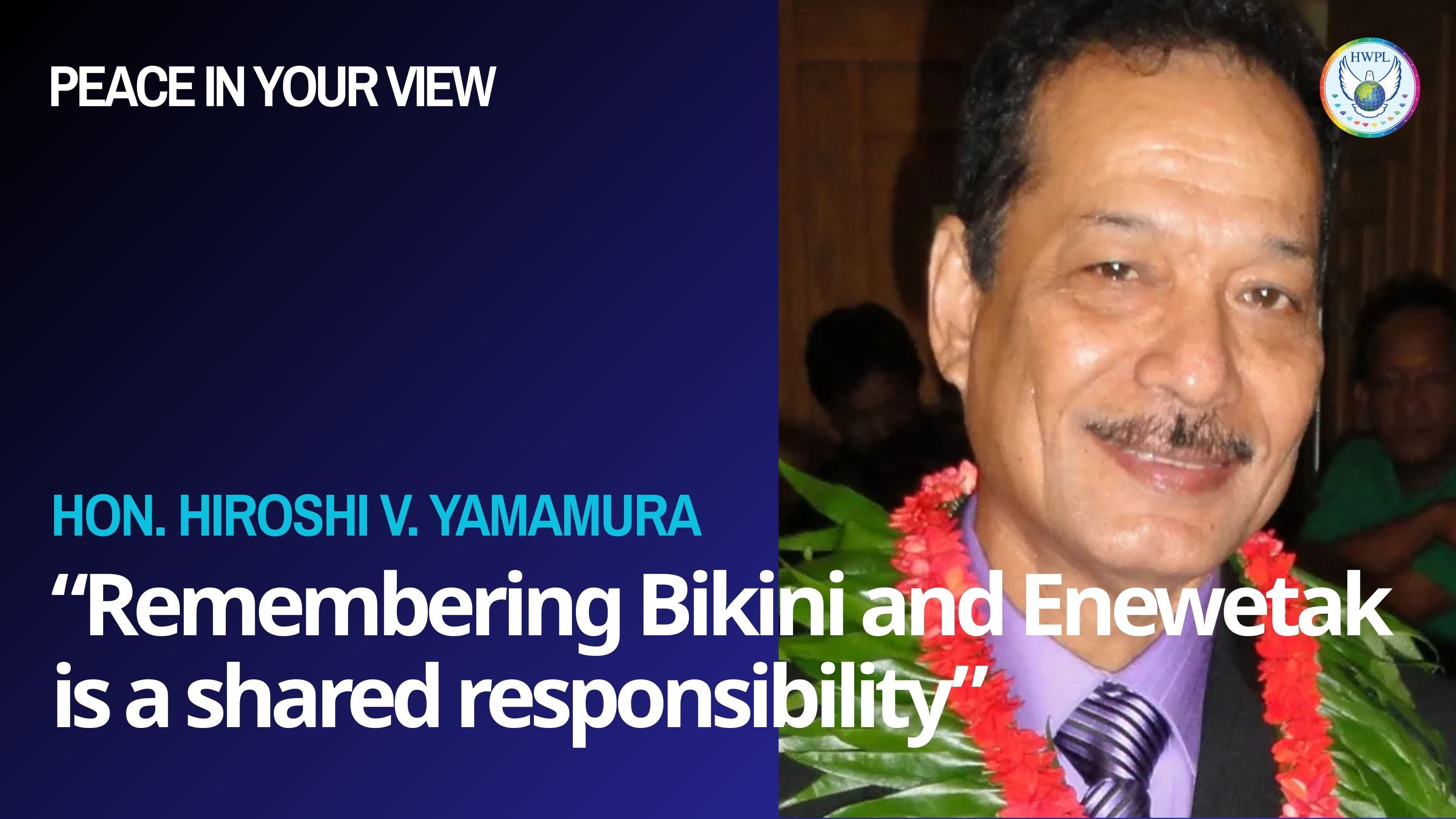
An Interview with Honorable Hiroshi V. Yamamura
Senator of the Republic of the Marshall Islands
Peace In Your View is an initiative developed under HWPL’s efforts to realize Article 10, Spreading a Culture of Peace, of the Declaration of Peace and Cessation of War (DPCW). By conducting in-depth interviews with individuals actively contributing to peace, the project seeks to illuminate diverse perspectives, experiences, and philosophies. Through stories shared by leaders, practitioners, and community members from various backgrounds, Peace In Your View aims to inspire readers to reflect on how they can promote peace, inclusion, and social cohesion in their own communities.
The Republic of the Marshall Islands carries one of the most painful legacies of nuclear testing in modern history. Between 1946 and 1958, nuclear tests conducted at Bikini Atoll and Enewetak Atoll displaced communities, caused severe environmental damage, and left long-lasting human suffering that continues to affect generations.
In this interview, Honorable Hiroshi V. Yamamura, a long-serving senator of the Republic of the Marshall Islands, shares his perspective on why preserving nuclear testing records is essential—not only for Marshallese society, but for the global community. Drawing on decades of public service, he reflects on historical memory, nuclear disarmament, and the role of international cooperation in transforming painful history into a legacy for peace.
Remembering Nuclear Testing as a Shared History
Q. Why is it important for Marshallese society, especially younger generations, to remember the history of nuclear testing at Bikini and Enewetak Atolls?
Preserving the history of nuclear testing is essential because it is deeply connected to Marshallese identity and collective memory. Entire communities were displaced, and the consequences of nuclear testing have shaped our society in lasting social, cultural, and environmental ways.
For younger generations, understanding this history helps explain not only the suffering of their ancestors, but also why issues such as nuclear disarmament and justice remain relevant today. Remembering this history is not about remaining in the past—it is about learning from it to prevent similar tragedies in the future.
Preserving Voices Before They Are Lost
Q. Many survivors’ memories and oral histories are at risk of fading over time. What efforts are most urgently needed today?
The most urgent task is to collect and preserve survivors’ testimonies, oral histories, and traditional knowledge while they are still available. These personal accounts reveal the human impact of nuclear testing in ways that official records alone cannot.
Without timely preservation, an irreplaceable part of our history may be lost. Ensuring that these stories are recorded and passed on allows future generations to learn directly from lived experience, rather than through distant interpretation.
Preserving Records as a Foundation for Truth
Q. When preserving the legacy of nuclear testing, what kinds of records are most important to safeguard?
It is important to preserve a wide range of materials that reflect both official documentation and lived experience. Oral testimonies, photographs, government archives, personal diaries, displacement records, videos, and community narratives each capture different dimensions of what occurred.
Together, these records reveal not only historical facts, but also the long-term human and environmental consequences endured by the Marshallese people. Preserving this diversity ensures that history is represented truthfully and comprehensively.
From National Experience to Global Responsibility
Q. How can preserving these records contribute to broader international understanding and responsibility?
Preserving these records gives international visibility to the Marshallese experience and affirms that our history carries meaning beyond national borders. When shared globally, these materials raise awareness about the real consequences of nuclear testing.
They also encourage dialogue and cooperation among nations on nuclear issues. In this way, preserving history is not only about remembrance—it is about strengthening global solidarity for peace and preventing future harm.
Memory, Peace Education, and Cooperation
Q. How do peace education efforts, including HWPL’s work, contribute to preserving historical memory and promoting peace in the Pacific region?
Peace education plays an essential role in transforming painful history into a foundation for peace. By sharing the history of Bikini and Enewetak Atolls, people can better understand the consequences of nuclear weapons and the importance of disarmament.
Organizations like HWPL contribute by connecting local histories with global peace education efforts and encouraging cooperation among communities, civil society, and international partners. Such collaboration ensures that historical memory supports reconciliation and lasting peace.
Looking Toward Future Generations
Q. What is your hope for future generations regarding the legacy of Bikini and Enewetak Atolls?
I hope future generations inherit a legacy of resilience and awareness. I want them to understand the past, continue advocating for nuclear disarmament, as a vital pathway toward the cessation of all forms of war, and recognize peace as a shared responsibility.
Final Reflection
Preserving nuclear testing records is not simply about recording history. It is about protecting truth, honoring human dignity, and building a foundation for peace. The preservation of these records serves as an essential foundation for realizing a world without war, as envisioned by the DPCW. Through memory, education, and international cooperation, the painful history of the Marshall Islands can contribute to a more just and peaceful future.
· Interviewer: Amanda Kim, General Director of Public Relations Department, HWPL Global 08 Branch
· Interviewee: Honorable Hiroshi Yamamura, Senator of the Republic of the Marshall Islands
This interview has been edited and finalized by the Public Relations Department of HWPL Global 08 Branch.
게시물 [Peace In Your View] Remembering Bikini and Enewetak: Nuclear Memory, Responsibility, and the Path to Peace이 에 처음 등장했습니다.